
The True Zero Spreadsheet is based on the generic figures in the EPiC database. These figures are calculated using a Hybrid approach.
(For more information about EPiC database and its data, it is highly recommended that you watch the Robert Crawford video in your pack, and download and read the manual from the EPiC database page that describes the methodology. https://msd.unimelb.edu.au/research/projects/current/environmental-performance-in-construction/download )
EPD's by comparison are typically calculated using a Process Analysis approach.
These 2 approaches are different, with the Hybrid approach typically having a broader collection boundary, capturing more data from the addition of Input-Output economic analysis, and arguably giving a fuller picture of actual total carbon emissions. Hybrid approaches will therefore typically have higher figures than an EPDs calculated using process analysis (which most of them are.)
Technically EPiC numbers and EPD's cannot therefore not be mixed and matched, and in the competition the official True Zero Spreadsheet (TZS) that you submit should only use the figures in EPiC that come pre-loaded.
So what then can you do if you find an EPD for a product with lower Global Warming Potential (GWP) carbon emissions figures compared to the True Zero Spreadsheet and you want to use the product and get some carbon savings?
The answer is there is nothing stopping you working out the likely savings and letting the judges know in a subsequent table submitted alongside the official TZS.
This is how EPD savings could be worked out...
Let's say you find an EPD for glasswool with a low A1-A3 GWP. (And all EPiC figures are A1-A3 boundary.)
1. Go to the EPiC manual and check out the material in question. Eg. Glasswool (see below)
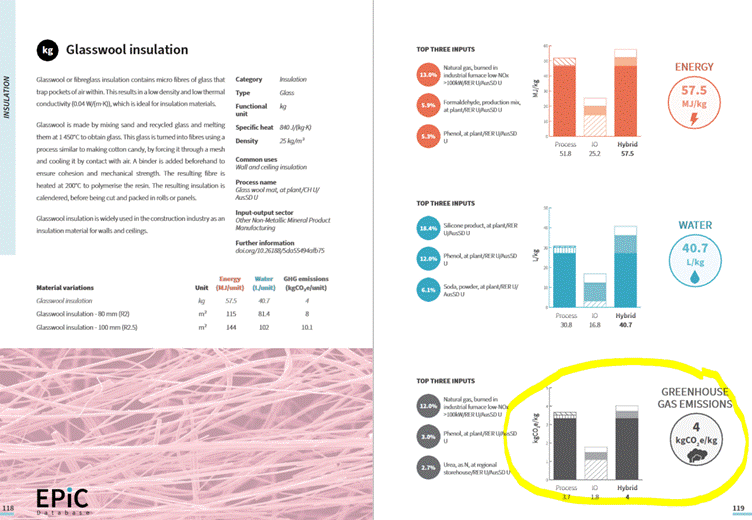
In this case it shows a carbon emission of 4kgCO2/kg using EPiC's Hybrid Analysis. From the graphs you can see that 3.7 of that came from Process Analysis.
2. Let say you found an EPD with a total GWP A1-A3 of 2kgCO2/kg. This EPD will likely have been calculated using a process analysis. So that's a saving of 1.7.
3. Work out the saving.
Eg. 4.0 -1.7 = 2.3kgCO2/kg for the now EPD adjusted hybrid number.
4. Work out the savings amount using this new number in your project.
5. You can present your savings in a secondary table that gives further information to the judges beyond the TZS score, and what the 'true' score might be if you counted the EPDs.
It should be noted however that this is a work around for this years competition.
Entrants don't have to go to this level of detail, but for those that want to get stuck into EPD selection this is encouraged and this method is a pathway that potential savings could be shown. Just please make sure that the EPD savings are done as a secondary calculation and that an official TZS file is still presented with the EPiC figures.
Was this article helpful?
That’s Great!
Thank you for your feedback
Sorry! We couldn't be helpful
Thank you for your feedback
Feedback sent
We appreciate your effort and will try to fix the article